- Open Source Ecology 4 Year Review: Efficiency is key to making open source technology viable. In December 2012, we have shown for the first time that one of our heavy machines, the Compressed Earth Block (CEB) Press, can be built in a single day. We combined modular design, digital fabrication, and swarm build techniques – for a rapid, parallel, Extreme Build. One Day.
- Gartner says lock-in technology will replace open source philosophy for 3D printers – and that should make everyone angry by +Adam Oxford: Gartner’s future is likely to pass if we don’t try and stop it now. In this future, big tech brands take over and fight to keep prices high by introducing new ‘features’ rather than continue to reduce the off-the-shelf cost of new printers. They lock people into artificially incompatible designs that are non-user serviceable. Even as raw feedstock prices drop due to demand, the move to proprietary cartridges that only fit one type of printer rather than generic spools of filament will keep end user costs high.
- How do you avoid being forked into oblivion? by +Stack Exchange: the founder of the project that was forked says: "The purpose of the MIT license is to unencumber your fair use. Not to encourage you to take software, rebrand it as your own, and then "take it in a new direction" as you say. While not illegal, it is unethical." It seems that the GitHub page of the new project doesn't even indicate that it's a fork in a typical GitHub manner...So my questions are: Was Xamarin's action and the way the action was done ethical or not? Is it possible to avoid such a situation if you are a single developer or a small unfunded group of developers?
- Investing in Junk Armies: Why US Efforts to Create Foreign Armies Fail by +William Astore: Bremer and his team vowed to create a new Iraqi military from scratch...Its main job would be to secure the country’s borders without posing a threat to Iraq’s neighbors or, it should be added, to U.S. interests...Despite years of work by U.S. military advisers and all those billions of dollars invested in training and equipment, the Iraqi army has not fought well, or often at all. Nor, it seems, will it be ready to do so in the immediate future...The simple answer: for a foreign occupying force to create a unified and effective army from a disunified and disaffected populace was (and remains) a fool’s errand. In reality, U.S. intervention, now as then, will serve only to aggravate that disunity
- New thoughts on capital in the twenty-first century by +Thomas Piketty's 'Capital in the Twenty-First Century': French economist Thomas Piketty caused a sensation in early 2014 with his book on a simple, brutal formula explaining economic inequality: r > g (meaning that return on capital is generally higher than economic growth). Here, he talks through the massive data set that led him to conclude: Economic inequality is not new, but it is getting worse, with radical possible impacts.
- Why Kids Sext by +Hanna Rosin: Usually Lowe can more or less classify types in his head—which kids from which families might end up in trouble after a drunken fight in the McDonald’s parking lot. But this time the cast of characters was baffling..."If she was a teenager with a phone, she was on there."...Lowe’s characterization of the girls on Instagram morphed from “victims” to “I guess I’ll call them victims” to “they just fell into this category where they victimized themselves.”...For the most part, the laws do not concern themselves with whether a sext was voluntarily shared between two people who had been dating for a year or was sent under pressure: a sext is a sext...Whether a sext qualifies as relatively safe sexual experimentation or a disaster often depends on who finds out about it.
Showing posts with label OSE. Show all posts
Showing posts with label OSE. Show all posts
16 February 2015
Link Dump 4


07 January 2012
Help Open Source Ecology Change The World
Don't worry about people stealing your ideas. If your ideas are any good, you'll have to ram them down people's throats.Howard Aiken
Sometimes you stumble across an idea that's so...well, BIG that it's hard to think about let alone describe. Open Source Ecology (OSE), founded by Marcin Jakubowski, is just such an idea. Basically, what OSE is doing is recreating the entire history of technological development, without all of the false-starts, and from an open-source frame of reference. Modern civilization depends on a system of industry. OSE is going to open-source the entire system. I said it was big. The end result will be all of the technology necessary to, as Marcin says, “transform local resources into the substance of advanced civilizations.”
The initial primary focus is developing the Global Village Construction Set (GVCS).
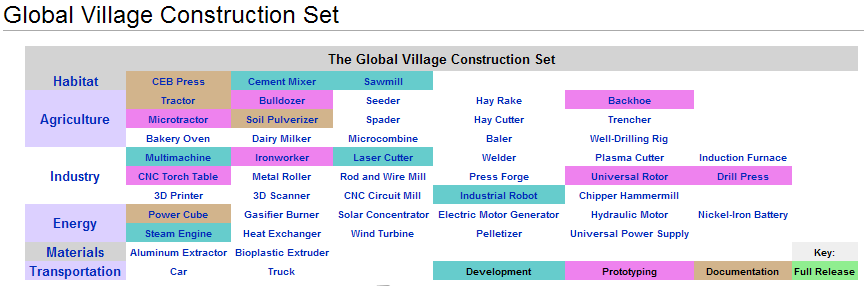
The GVCS is a system of machines that, working together, can create a small, sustainable civilization with modern levels of technology. Starting from scratch, or from scrap, a small group of people could produce everything they need to survive and thrive.
Perhaps the most important point to consider is that the GVCS will be integrated. Each machine will be designed to maximize the performance of the entire system, not the performance of the machine itself. For example, rather than build engines into every machine, interchangeable “power cubes” will keep things moving. The flexibility to provide power to anything, anywhere, will more than offset the loss of mechanical efficiency at each machine.
They just barely failed to make it into the top 5 Best of TED 2011 over at Huffington Post, and they've been covered in the press for several years now. The wiki, which is more-or-less the central organizational structure, has a crash course. OSE just released the first 1% of the GVCS and plans to release the other 99% by year end 2012, in accordance with their Enterprise Plan.
Publications take on different forms depending on the organization doing the work. OSE is a non-profit obsessively dedicated to the principle that everyone benefits faster from doing things open-source. Contrasted against closed-source, going “open” means they actively publish their work in such a way that the entire world has all the information necessary to replicate it. When OSE shows off a brick press that works twice as fast as its commercial equivalents they follow it up by creating a detailed set of instructions. Eventually, the entire GVCS will be designed and documented. The first four machines are in the Civilization Starter Kit.
The CSK (v0.01) treads the first step on the road to industrial independence. The CSK contains all the information necessary to build the “lowest hanging fruit” of the 50 machines in the GVCS. Highlighted in brown, they are a tractor (LifeTrac), a compressed earth block press (Liberator), a soil pulverizer and a power source (Power Cube). With these tools, two people can use dirt at the construction site to create enough bricks for a house in a single day!
You don't have to pay for the instructions. Typically, the sole restriction of an open-source license is that whatever improvements you make to the machines you must release under a similar open-source license.
The important thing to communicate at this stage is that open-source technology depends on replication and guided evolution for its unmistakable cost and performance advantages. The Power Cube, LifeTrac, Soil Pulverizer (a cultivator) and Liberator have all moved beyond their first generation designs while being incubated at Factor E Farm. The next stage is for a hundred people to independently build, evaluate and refine them.
It seems to me that the most fertile soil in which to plant these designs, specifically the LifeTrac, is in the hands of the world's small and independent farmers. It can be fabricated for about $10,000 in materials, is designed to last 100 years, and has ownership costs 1/10th to 1/100th of a commercial skid-steer loader.
More importantly, the LifeTrac is a taste of what's to come. Open-source hardware is just starting to become a “thing” but for something so new it is showing remarkable promise. For example, only a few years ago Dr. Adrian Bowyer invented the RepRap, a 3D printer, and released the designs open-source. Today a RepRap costs between $500-$1,000 and surpasses the performance of commercial systems, none of which drop below $10,000.
It's not outside the realm of possibility that the LifeTrac will have one fifth the cost and twice the performance of its commercial counterparts in only a few years. Just imagine how much time and money that would free up for farmers who are already overburdened with debt. Then, imagine an entire system of machines going through the same dramatic evolution.
First, however, OSE needs people to use its machines in the real world.
This is a call to action. If you are at all interested in the GVCS then OSE wants to hear from you. Their plan is to have hundreds, if not thousands, of people/organizations replicating their machines by the end of 2012. The benefits will be immediate, because the machines in the GVCS are high-value alternatives to existing machines, and perpetual, because any improvements will be incorporated into the GVCS in a matter of months.
Subscribe to:
Posts (Atom)

 Posts
Posts

