Showing posts with label change. Show all posts

07 January 2012

Help Open Source Ecology Change The World

Don't worry about people stealing your ideas. If your ideas are any good, you'll have to ram them down people's throats.Howard Aiken


Sometimes you stumble across an idea that's so...well, BIG that it's hard to think about let alone describe. Open Source Ecology (OSE), founded by Marcin Jakubowski, is just such an idea. Basically, what OSE is doing is recreating the entire history of technological development, without all of the false-starts, and from an open-source frame of reference. Modern civilization depends on a system of industry. OSE is going to open-source the entire system. I said it was big. The end result will be all of the technology necessary to, as Marcin says, “transform local resources into the substance of advanced civilizations.”


The initial primary focus is developing the Global Village Construction Set (GVCS).
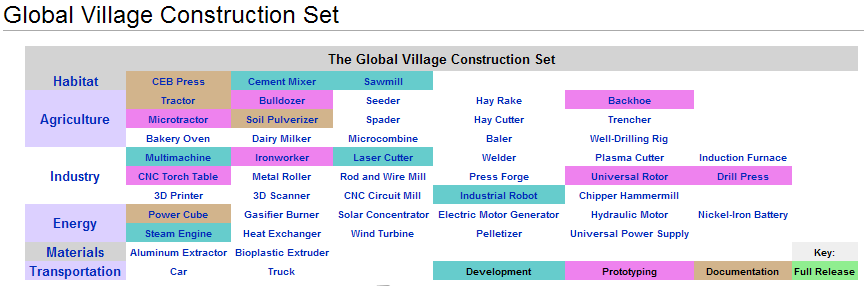

The GVCS is a system of machines that, working together, can create a small, sustainable civilization with modern levels of technology. Starting from scratch, or from scrap, a small group of people could produce everything they need to survive and thrive.

Perhaps the most important point to consider is that the GVCS will be integrated. Each machine will be designed to maximize the performance of the entire system, not the performance of the machine itself. For example, rather than build engines into every machine, interchangeable “power cubes” will keep things moving. The flexibility to provide power to anything, anywhere, will more than offset the loss of mechanical efficiency at each machine.

They just barely failed to make it into the top 5 Best of TED 2011 over at Huffington Post, and they've been covered in the press for several years now. The wiki, which is more-or-less the central organizational structure, has a crash course. OSE just released the first 1% of the GVCS and plans to release the other 99% by year end 2012, in accordance with their Enterprise Plan.

Publications take on different forms depending on the organization doing the work. OSE is a non-profit obsessively dedicated to the principle that everyone benefits faster from doing things open-source. Contrasted against closed-source, going “open” means they actively publish their work in such a way that the entire world has all the information necessary to replicate it. When OSE shows off a brick press that works twice as fast as its commercial equivalents they follow it up by creating a detailed set of instructions. Eventually, the entire GVCS will be designed and documented. The first four machines are in the Civilization Starter Kit.

The CSK (v0.01) treads the first step on the road to industrial independence. The CSK contains all the information necessary to build the “lowest hanging fruit” of the 50 machines in the GVCS. Highlighted in brown, they are a tractor (LifeTrac), a compressed earth block press (Liberator), a soil pulverizer and a power source (Power Cube). With these tools, two people can use dirt at the construction site to create enough bricks for a house in a single day!

You don't have to pay for the instructions. Typically, the sole restriction of an open-source license is that whatever improvements you make to the machines you must release under a similar open-source license.

The important thing to communicate at this stage is that open-source technology depends on replication and guided evolution for its unmistakable cost and performance advantages. The Power Cube, LifeTrac, Soil Pulverizer (a cultivator) and Liberator have all moved beyond their first generation designs while being incubated at Factor E Farm. The next stage is for a hundred people to independently build, evaluate and refine them.

It seems to me that the most fertile soil in which to plant these designs, specifically the LifeTrac, is in the hands of the world's small and independent farmers. It can be fabricated for about $10,000 in materials, is designed to last 100 years, and has ownership costs 1/10th to 1/100th of a commercial skid-steer loader.

More importantly, the LifeTrac is a taste of what's to come. Open-source hardware is just starting to become a “thing” but for something so new it is showing remarkable promise. For example, only a few years ago Dr. Adrian Bowyer invented the RepRap, a 3D printer, and released the designs open-source. Today a RepRap costs between $500-$1,000 and surpasses the performance of commercial systems, none of which drop below $10,000.

It's not outside the realm of possibility that the LifeTrac will have one fifth the cost and twice the performance of its commercial counterparts in only a few years. Just imagine how much time and money that would free up for farmers who are already overburdened with debt. Then, imagine an entire system of machines going through the same dramatic evolution.

First, however, OSE needs people to use its machines in the real world.

This is a call to action. If you are at all interested in the GVCS then OSE wants to hear from you. Their plan is to have hundreds, if not thousands, of people/organizations replicating their machines by the end of 2012. The benefits will be immediate, because the machines in the GVCS are high-value alternatives to existing machines, and perpetual, because any improvements will be incorporated into the GVCS in a matter of months.

27 October 2010

Wright is Right. Also, ice cubes.

The thing about people is that they have two sides. One side is emotional and short-sighted and blind to the world outside of its immediate grasp. The other side doesn't exist.

Well, it exists, but it's not very important. We can be rational, we just can't be rational if any one of a number of emotions are out of balance. For example, if you're reading this you're probably not getting angry (not yet). You're probably thinking about things, like ideas or something abstract, and not THAT SUICIDE BOMBER BEHIND YOU!!1


Fear is probably the most commonly experienced emotion in the entire world because the natural reaction to something we don't understand is fear...and there's a lot we don't understand.

Of course, to really be afraid of something we have to become aware of it so that we can know we don't understand it. For most of America, 9/11 was one of those moments. There was the time before 9/11 when most of us were blissfully ignorant of radical Islam, and the time after 9/11 when we realized that THREE religions spun off of Abraham's covenant with God.

And, of course, the previous sentence is totally unfair. it conflates religion with politics, pretends a religion is the same as radical elements of that religion, and is also a bit snarky.


Anywho, I had a point. Yes, the point was that Robert Wright has a point.

As Islamophobia grows, it alienates Muslims, raising the risk of homegrown
terrorism — and homegrown terrorism heightens the Islamophobia, which alienates more Muslims, and so on: a vicious circle that could carry America into the abyss
.


Wright goes on to point out that it is no longer cool, in mainstream culture, to be disrespectful to gay people. His thesis is that since gay people were already everwhere, pretty much everyone already knew a gay person, they just didn't know they knew a gay person. When those people started to come out, homophobes realized that it was kind of stupid to be afraid of someone you've known and liked for a long time just because you suddenly became aware of their sexual orientation.


Being nice to gay people is now so important that the President Of The United States made a special video to help out a successful national movement. What he didn't do was make a special video reminding Americans that Muslims are no worse than Christians. He didn't do that because islamophobia is on the rise, and if there's one thing a leader (hope and change!) avoids doing it's making an enlightened but unpopular statement.


I'd like to build on Wright's thesis a bit and suggest that the reason islamophobia is going to get worse before (if) it gets better is that there's little chance any American is going to meet a Muslim. Less than 1% of the population of America is Muslim. And they tend to cluster together. So most Americans only hear about Muslims, and in the same way no one ever hears about all the planes that landed safely yesterday no one ever hears about all the Muslims who didn't blow anything up. But, more importantly, all the Muslims in America represent only 0.2% of the global Muslim population.

This means that there is no real chance Americans will ever think of Muslims as anything other than "them." Even if the Muslim population in America grew and distributed so that most Americans got the chance to live and work with them, all of those new Muslims would still represent an exception.


Now, the monkeysphere. We're only capable of knowing, like, 150 people at any one time. Everyone else is either someone we've forgotten or a stranger. And it's not like people are just going to decide to forget 10 people, it has to happen naturally. So the problem we have is that building up the kind of experience with a stranger that brings them into your monkeysphere takes consistent effort over a long period of time. And it's basically impossible if they're not right next to you.

The population of Muslims is so small, and so concentrated in distinct regions,
that there weren’t enough such encounters to yield statistically significant
data. And, as Putnam and Campbell note, this is a recipe for prejudice. Being a
small and geographically concentrated group makes it hard for many people to
know you, so not much bridging naturally happens.


Since the average American doesn't have the chance to get to know Muslims even if they are currently open to the idea, they have to get an overview from someone who claims to know some Muslims. Most of those overviews are not flattering.


If you think about all of America like one organization (LOL you should) then theories of organizational change are applicable. They all tend to incorporate the unfreeze/refreeze model in one form or another. Basically, people start out in a sort of structure, and if you want them to take on a different structure you have to first shake them up.


Well, the overall situation is quite conductive to structuring Americans around the thought that Muslims are "them." There are a lot, but none of them are nearby, and they tend to disagree with us. None of that is going to change. So, what happens when people get shaken up anyway?

Well, if you let an ice cube melt it will take on a new shape. If it then refreezes in that random shape, instead of the one you wanted (a dinosaur), you've got only yourself to blame. In this case no one individual is responsible for the structure of America, but there are individuals responsible for shaking people up and then, at best, not giving them a good shape to refreeze into, and at worst deliberately encouraging them to refreeze around negative thoughts.

So the engineering challenge in building bridges between Muslims and non-Muslims will be big. Still, at least we grasp the nuts and bolts of the situation. It’s
a matter of bringing people into contact with the “other” in a benign
context...Philanthropists need to figure out how you build lots of little
bridges at the grass roots level. And they need to do it fast.

If any situation cries out for understanding systems, innovating, and leadership it's this one...but I have to admit that I'm at a loss. Personally, I think a significant percentage of America has already refrozen around a strongly anti-Islamic world view, and now they're working on shaking up (unfreezing) everyone else.