- Open Source Ecology 4 Year Review: Efficiency is key to making open source technology viable. In December 2012, we have shown for the first time that one of our heavy machines, the Compressed Earth Block (CEB) Press, can be built in a single day. We combined modular design, digital fabrication, and swarm build techniques – for a rapid, parallel, Extreme Build. One Day.
- Gartner says lock-in technology will replace open source philosophy for 3D printers – and that should make everyone angry by +Adam Oxford: Gartner’s future is likely to pass if we don’t try and stop it now. In this future, big tech brands take over and fight to keep prices high by introducing new ‘features’ rather than continue to reduce the off-the-shelf cost of new printers. They lock people into artificially incompatible designs that are non-user serviceable. Even as raw feedstock prices drop due to demand, the move to proprietary cartridges that only fit one type of printer rather than generic spools of filament will keep end user costs high.
- How do you avoid being forked into oblivion? by +Stack Exchange: the founder of the project that was forked says: "The purpose of the MIT license is to unencumber your fair use. Not to encourage you to take software, rebrand it as your own, and then "take it in a new direction" as you say. While not illegal, it is unethical." It seems that the GitHub page of the new project doesn't even indicate that it's a fork in a typical GitHub manner...So my questions are: Was Xamarin's action and the way the action was done ethical or not? Is it possible to avoid such a situation if you are a single developer or a small unfunded group of developers?
- Investing in Junk Armies: Why US Efforts to Create Foreign Armies Fail by +William Astore: Bremer and his team vowed to create a new Iraqi military from scratch...Its main job would be to secure the country’s borders without posing a threat to Iraq’s neighbors or, it should be added, to U.S. interests...Despite years of work by U.S. military advisers and all those billions of dollars invested in training and equipment, the Iraqi army has not fought well, or often at all. Nor, it seems, will it be ready to do so in the immediate future...The simple answer: for a foreign occupying force to create a unified and effective army from a disunified and disaffected populace was (and remains) a fool’s errand. In reality, U.S. intervention, now as then, will serve only to aggravate that disunity
- New thoughts on capital in the twenty-first century by +Thomas Piketty's 'Capital in the Twenty-First Century': French economist Thomas Piketty caused a sensation in early 2014 with his book on a simple, brutal formula explaining economic inequality: r > g (meaning that return on capital is generally higher than economic growth). Here, he talks through the massive data set that led him to conclude: Economic inequality is not new, but it is getting worse, with radical possible impacts.
- Why Kids Sext by +Hanna Rosin: Usually Lowe can more or less classify types in his head—which kids from which families might end up in trouble after a drunken fight in the McDonald’s parking lot. But this time the cast of characters was baffling..."If she was a teenager with a phone, she was on there."...Lowe’s characterization of the girls on Instagram morphed from “victims” to “I guess I’ll call them victims” to “they just fell into this category where they victimized themselves.”...For the most part, the laws do not concern themselves with whether a sext was voluntarily shared between two people who had been dating for a year or was sent under pressure: a sext is a sext...Whether a sext qualifies as relatively safe sexual experimentation or a disaster often depends on who finds out about it.
16 February 2015
Link Dump 4


15 February 2015
Link Dump 3
- How municipalities in St. Louis County, Mo., profit from poverty by +Radley Balko: It’s a common and unfortunate misconception among St. Louis County residents, especially those who don’t have an attorney to tell them otherwise. A town can’t put you in jail for lacking the money to pay a fine. But you can be jailed for not appearing in court to tell the judge you can’t pay...Some of the towns in St. Louis County can derive 40 percent or more of their annual revenue from the petty fines and fees collected by their municipal courts.
- What the Media Gets Wrong About Israel by +Matti Friedman: The Western press has become less an observer of this conflict than an actor in it...I want to explore the way Western press coverage is shaped by unique circumstances here in Israel and also by flaws affecting the media beyond the confines of this conflict.
- 3 Improv Comedy Tricks To Supercharge Your Social Life by +John Freund: That decision to pretend I knew what I was doing led to a memorable and hilarious scene involving a family reunion inside a cave (we discovered a ‘lost boy’ who happened to be our cousin left over from the last reunion). And it all happened because I didn’t let my lack of confidence get the better of me. In short, I faked in with confidence.
- Antonyms for entropy: Some of my favorites are syntropy and ektropy.
- Natural distribution: Assuming you get a certain chance once per day, a twice-in-a-lifetime thing is 1 in 16,000, so your True Love is one in 16,000, not one in a million.
- The Other Side of Diversity by +Erica Joy: I’ve searched for, and have been disappointed to find that few studies have been done on the psychological effects of being a minority in a mostly homogeneous workplace for an extended period of time. Here I’ll try to highlight how it has affected me, as I grew from a young black lady to a black woman in the predominantly white male tech industry.
- Why I left my $254,895 PM role at Microsoft by +Adam Herscher: I’ll just say… to the child of an immigrant and middle class family, raised of sufficient but not excessive means, I can only describe that number as feeling both grossly obscene while at the same time a bit like: “Well, I’ve made it.” Whereas the things I valued most early on in my career had been achieved, other ambitions in life were slipping further away with each year.
- The Kuleshov Effect: It is a mental phenomenon by which viewers derive more meaning from the interaction of two sequential shots than from a single shot in isolation.
- Violence Is Currency: A Pacifist Ex-Con's Guide To Prison Weaponry by +Daniel Genis: Every incident I witnessed in prison, except for the melees that we had to break up when I worked in a unit for the mentally ill, was premeditated and done with purpose, however twisted that purpose was. The violence functioned as a tool for preserving order, whether to maintain the hierarchies of prisoners or to reassert the authority of the guards. It was the best form of currency we had.
- Reproducing Wealth Without Money, One 3D Printer At a Time by +Johan Söderberg: The Rep-rap project sets out to provide one piece of the puzzle in a larger peer-to-peer manufacturing infrastructure. With such an infrastructure in place, engineers can bypass fixed capital. It is a roadmap for the “exodus” of engineering practices from wage labour relations and (which is the same thing) from commodity production. The role assigned to “self-replication” in this larger scheme of things, although framed within a conceptual framework of evolutionary laws and technical determinism, testifies to the very opposite, the importance of design choices. The kind of 3D-printer that can reproduce itself (in symbiosis with human beings) is designed to ensure the community’s functional autonomy from corporations and venture capital.
Link Dump 2
- A fault in our design by +Colin Dickey: Even a quick round-up of the technological advances of the past few decades suggests that we’re steadily moving forward along an axis of progress in which old concerns are eliminated one by one...the same technologies that are making our lives easier are also bringing new, often unexpected problems.
- What I Wish I Knew When I Started My Career as a Software Developer by +Michael O. Church: Let me bat out a few suggestions based on my experience and observations. This list is not all-inclusive—because it can't be. Your experience will be unique.
- 7 questions to ask any open source project by +Simon Phipps: Do you truly have permission granted in advance to benefit from and innovate upon an open source project? These questions will help you find out
- On The Origin of Circuits by +Alan Bellows: Dr. Thompson dabbled with computer circuits in order to determine whether survival-of-the-fittest principles might provide hints for improved microchip designs...what he found inside was baffling. The plucky chip was utilizing only thirty-seven of its one hundred logic gates, and most of them were arranged in a curious collection of feedback loops. Five individual logic cells were functionally disconnected from the rest-- with no pathways that would allow them to influence the output-- yet when the researcher disabled any one of them the chip lost its ability to discriminate the tones. Furthermore, the final program did not work reliably when it was loaded onto other FPGAs of the same type.
- Here's What Would Happen If You Asked Ayn Rand To Loan You Money by +Lauren Davis: Naturally, Rand couldn't resist answer a request for a loan with a dissertation on fiscal responsibility. While there is some sensible stuff in here (and hey, at least she admits that Connie doesn't have to agree with her personal philosophy), most communications with teenage girls don't turn into a miniature version of Atlas Shrugged, paired with threats of viewing them as embezzlers.
- The Subtle Art of Not Giving A Fuck by +Mark Manson: In my life, I have given a fuck about many people and many things. I have also not given a fuck about many people and many things. And those fucks I have not given have made all the difference.
- Lost in the Meritocracy by +walter kirn: Someday we'll be screened and then separated...Four years ago my SAT scores set me on a trajectory...I knew only one direction: forward, onward. I lived for prizes, praise, distinctions, and I gave no thought to any goal higher or broader than my next report card. Learning was secondary; promotion was primary. No one had ever told me what the point was, except to keep on accumulating points, and this struck me as sufficient. What else was there?
- Decentralized Autonomous Organization: sometimes referred to as a Fully Automated Business Entity or Distributed Autonomous Corporation/Distributed Autonomous Company...It can be thought of as a corporation run without any human involvement under the control of an incorruptible set of business rules. These rules are typically implemented as publicly auditable open-source software distributed across the computers of their stakeholders. A human becomes a stakeholder by buying stock in the company or being paid in that stock to provide services for the company. This stock may entitle its owner to a share of the profits of the DAO, participation in its growth, and/or a say in how it is run.
Link Dump 1
- 3D printing trends January 2015: This trend report provides a comprehensive and unmatched perspective on the current state of the 3D printing industry. Based on data from our 3D Hubs community, which includes over 10000 printers in over 120 countries, and thousands of 3D print orders every month, we are excited to show you the printers people love and what’s trending in the world of 3D Printing.
- Long Term (vehicle) Quality Index: The Long-Term Quality Index is a collaborative project between +Steve Lang and +Nick Lariviere, designed to give the average car buyer a picture of what the long-term reliability of different makes and models are based on real-world used vehicle data.
- The Nature of Code by +Daniel Shiffman: This book focuses on the programming strategies and techniques behind computer simulations of natural systems using Processing.
- How Fractal Trees Work by +Bradley C. Kuszmaul at CRIBB, November 4 2011 (pdf): Is there a data structure that is about as good as a B-tree for lookup, but has insertion performance closer to append? Yes, Fractal Trees!
- Mission: Funding all those small but important open-source projects by +Steven J. Vaughan-Nichols: ...the problem is that there are still many small but important programs that don't get the headlines and millions of dollars of a Docker, Linux, or OpenStack. These projects get swept under the carpet even though, as Heartbleed proved, they're absolutely vital to modern IT...the Core Infrastructure Initiative (CII) has helped fund such tiny but significant programs as the Network Time Protocol (NTP), OpenSSH, and OpenSSL. It hasn't been enough.
- +Andreas Antonopoulos: “Give Bitcoin Two Years” by +Hal M. Bundrick: Antonopoulos proclaimed. It’s a dumb network that supports smart devices, pushing all of the intelligence to the edge. “That means if you build a new application on top of bitcoin, you can operate the end devices and you can build an application, and you don’t need to ask for anyone’s permission to innovate. It’s innovation without permission. It’s innovation without central approval.”
- Answering the Call for +Werner Koch’s Everywhere by +Jim Zemlin: In addition to the world’s email encryption software being managed by one person, the Internet is being secured by two guys named Steve. The Network Time Protocol that manages clock synchronization for the world’s computer systems is largely maintained by a couple of folks. The examples go on.
- Legalese and coding? Yup, it's the open-source FOSDEM shindig by +Damon Hart-Davis: Where there's maturity and money there's lawyers; debugging the minutiae, a low-key dull-but-worthy message from FOSDEM. (I declare a bias, given that my IoT startup is founded on the principle of enabling a market by commoditisation of parts of it via FOSSH (free/open source software and hardware. Investors and bureaucrats no longer look at me as if I have two heads!)
- Are coders worth it? by +James Somers: On Thursday night I got an unexpected email. It was a job offer, and these were the terms: $120,000 in salary, a $10,000 signing bonus, stock options, a free gym membership, excellent health and dental benefits, a new cellphone, and free lunch and dinner every weekday. My working day would start at about 11am. It would end whenever I liked, sometime in the early evening. The work would rarely strain me. I’d have a lot of autonomy and responsibility. My co-workers would be about my age, smart, and fun. I put my adventure on hold.
07 January 2012
Help Open Source Ecology Change The World
Don't worry about people stealing your ideas. If your ideas are any good, you'll have to ram them down people's throats.Howard Aiken
Sometimes you stumble across an idea that's so...well, BIG that it's hard to think about let alone describe. Open Source Ecology (OSE), founded by Marcin Jakubowski, is just such an idea. Basically, what OSE is doing is recreating the entire history of technological development, without all of the false-starts, and from an open-source frame of reference. Modern civilization depends on a system of industry. OSE is going to open-source the entire system. I said it was big. The end result will be all of the technology necessary to, as Marcin says, “transform local resources into the substance of advanced civilizations.”
The initial primary focus is developing the Global Village Construction Set (GVCS).
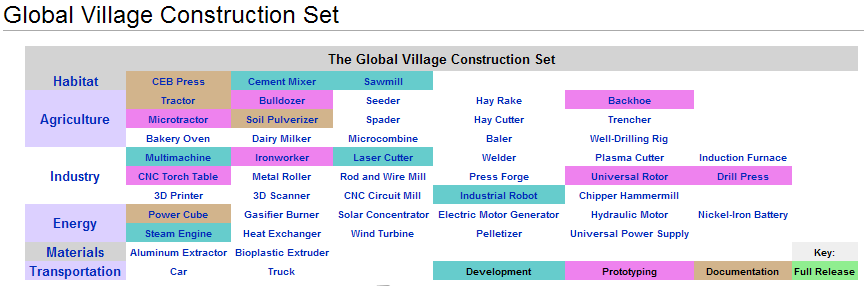
The GVCS is a system of machines that, working together, can create a small, sustainable civilization with modern levels of technology. Starting from scratch, or from scrap, a small group of people could produce everything they need to survive and thrive.
Perhaps the most important point to consider is that the GVCS will be integrated. Each machine will be designed to maximize the performance of the entire system, not the performance of the machine itself. For example, rather than build engines into every machine, interchangeable “power cubes” will keep things moving. The flexibility to provide power to anything, anywhere, will more than offset the loss of mechanical efficiency at each machine.
They just barely failed to make it into the top 5 Best of TED 2011 over at Huffington Post, and they've been covered in the press for several years now. The wiki, which is more-or-less the central organizational structure, has a crash course. OSE just released the first 1% of the GVCS and plans to release the other 99% by year end 2012, in accordance with their Enterprise Plan.
Publications take on different forms depending on the organization doing the work. OSE is a non-profit obsessively dedicated to the principle that everyone benefits faster from doing things open-source. Contrasted against closed-source, going “open” means they actively publish their work in such a way that the entire world has all the information necessary to replicate it. When OSE shows off a brick press that works twice as fast as its commercial equivalents they follow it up by creating a detailed set of instructions. Eventually, the entire GVCS will be designed and documented. The first four machines are in the Civilization Starter Kit.
The CSK (v0.01) treads the first step on the road to industrial independence. The CSK contains all the information necessary to build the “lowest hanging fruit” of the 50 machines in the GVCS. Highlighted in brown, they are a tractor (LifeTrac), a compressed earth block press (Liberator), a soil pulverizer and a power source (Power Cube). With these tools, two people can use dirt at the construction site to create enough bricks for a house in a single day!
You don't have to pay for the instructions. Typically, the sole restriction of an open-source license is that whatever improvements you make to the machines you must release under a similar open-source license.
The important thing to communicate at this stage is that open-source technology depends on replication and guided evolution for its unmistakable cost and performance advantages. The Power Cube, LifeTrac, Soil Pulverizer (a cultivator) and Liberator have all moved beyond their first generation designs while being incubated at Factor E Farm. The next stage is for a hundred people to independently build, evaluate and refine them.
It seems to me that the most fertile soil in which to plant these designs, specifically the LifeTrac, is in the hands of the world's small and independent farmers. It can be fabricated for about $10,000 in materials, is designed to last 100 years, and has ownership costs 1/10th to 1/100th of a commercial skid-steer loader.
More importantly, the LifeTrac is a taste of what's to come. Open-source hardware is just starting to become a “thing” but for something so new it is showing remarkable promise. For example, only a few years ago Dr. Adrian Bowyer invented the RepRap, a 3D printer, and released the designs open-source. Today a RepRap costs between $500-$1,000 and surpasses the performance of commercial systems, none of which drop below $10,000.
It's not outside the realm of possibility that the LifeTrac will have one fifth the cost and twice the performance of its commercial counterparts in only a few years. Just imagine how much time and money that would free up for farmers who are already overburdened with debt. Then, imagine an entire system of machines going through the same dramatic evolution.
First, however, OSE needs people to use its machines in the real world.
This is a call to action. If you are at all interested in the GVCS then OSE wants to hear from you. Their plan is to have hundreds, if not thousands, of people/organizations replicating their machines by the end of 2012. The benefits will be immediate, because the machines in the GVCS are high-value alternatives to existing machines, and perpetual, because any improvements will be incorporated into the GVCS in a matter of months.
15 November 2011
Freedombox, A Suggestion
The Freedombox is an idea who's time has come. Unfortunately, it's still just an idea.
Why is it still "just" an idea? Joshua Spodek has some thoughts. To paraphrase: it's probably because the idea isn't perfect yet (engineers are notorious for never being ready to release their work). He figures someone (or someones) needs to step up and organize an effort, no matter how poor the initial outcome might be. Once SOMETHING is out there it can be improved by feedback from actual users.

Pictured: users.
I agree that open-source projects either publish or cease to exist. OS projects just don't work until a person or a small group takes responsibility for getting results. Ideas are a great contribution, but someone has to contribute time and money too. Arguably an idea that can't attract even one person to take responsibility for it must not be a very good idea.
Freedombox is a great idea. We need to shift the momentum of the internet back to individual control.
That being the case, why hasn't the idea gotten more attention?
At the moment it catches the attention of people who 1) understand technology and 2) are not invested in using it to control people (for one reason or another). Unfortunately that means the vast majority of the world is not, and possibly WILL not, be captivated by the idea.

Getting a lot of people to use one is kind of the whole point of the freedombox concept, so failing to capture the collective imagination is pretty much total failure period. Therefore, it seems to me that a big part of getting some momentum behind the idea is getting people interested in it.
Or, failing that, latching onto something people are already interested in.

Time to get sneaky.
On average, people don't care about security. They will instantly compromise every single security precaution established if it saves them a moment's frustration. They will not "opt in." So, to get them to do secure things, you have to restructure their environment such that they must "opt out."
Rather than focusing on all the security advantages of the freedombox, emphasize its NON-security features. For example don't advertise the idea as a personal security initiative (freedom from oppression), instead advertise it as a personal cloud initiative (freedom from
cost/frustration). THEN build in all the security stuff you would have anyway. Tell people that's all there to guarantee the security of their cloud data. People love the idea of the cloud right now, and arguably a bunch of freedomboxes working together would fit under that umbrella.
The project could still be called "freedombox" and the product could still be pretty much the same as before, just change the marketing.
The strength of the idea is that it is the most "inherently" secure of all the options. When your data is on a company's servers it's under THEIR control. When your data is in your closet it's under YOUR control. In every society a person's home is considered more sacred than anywhere else. If an entity (cops or criminals) has to break into some faceless corporation to compromise you, that's one thing. When they have to go into your personal residence, that's an entirely different thing. No only is it simply physically easier to protect your dat
a when it's at home, but the government (even if it's corrupt) is far more likely to extend extra protections under the law to anything in your home.
Play up all the ways the freedombox will "free" people to go anywhere and still have access to their data. It will absolutely accomplish that goal. When people embrace that they'll also be getting all the security built into the gadget by its creators. If they want to turn that stuff off, they can. It's theirs and they can do what they want. Since it's open-source someone will probably even create a security-lite release that runs on the same hardware. Whatever. All the people grabbing up the "personal cloud" will create momentum that will help out the people who live under repressive governments.

Trickle down freedom.
Basically, attach the idea to something that's already popular and it will get a lot more support. Play up one or two features that appeal to the largest audience. That way the few people who can REALLY benefit from it will get it even though they would never have been able to create enough momentum on their own.
14 November 2010
Cloud Manufacturing and IP Law
The cool thing about innovation, as I've discussed before, is that it can only ever increase the number of options available to us. The invention of the nuclear ICBM didn't render knives obsolete.

However, there is an exception to that rule, at least in practice. There was one innovation in human history that made it possible to limit our options...that innovation was lawyers.

Sexy, sexy lawyers.
The emerging accessibility of 3D printing is eventually going to get a lot of attention in the courts. Things like patent, copyright, and trademark law have always been crafted under the assumption that it's really difficult to make physical objects. For example, consider a pen (any kind of pen, really). If you had to make a pen yourself you'd probably end up using a feather, because the machinery necessary to make something like a ball-point pen is impossible for anyone to afford unless they're in the business of making ball-point pens. Thus, ball-point pen manufacturers are really only worried about other ball-point pen manufacturers.

Also, this thing.
That is going to change. Not over night, but in the next decade it will become possible for an average, middle-class person to print a ball-point pen for nothing more than the cost of raw materials, and in less time than it takes to make popcorn.
All sorts of industries are going to feel threatened by 3D printing technology. Picture the recording industry back when things like VCRs and MP3s were introduced to the market. Or take a look at the journalism industry. Sure, there will always be demand for professional journalists, but it turns out people are remarkably in favor of the idea of making their own journalism (blogs), even if it is of questionable quality, because it's custom and it's instant. The same thing applies to movies, music, books, comics, videos, etc.

You can pick any two.
The ability to make something exactly the way you want, exactly when and where you want it, will be a huge leap forward in technology. As technological progress marches forward "cloud" manufacturing is going to emerge from the simple fact that the tools for making things will be cheap and abundant, rather than expensive and limited like they are now. How rocky the transition becomes will depend on which side mobilizes first.
Michael Weinberg wrote a paper that's posted over at Public Knowledge titled, "It Will Be Awesome If They Don't Screw It Up." It is basically the American counterpart to Dr. Bowyer's (and friends) paper titled, "The Intellectual Property Implications of Low-cost 3D Printing." The legal situation in Europe is slightly different from America in that indivduals can copy patents for their own personal use, whereas in America any copying of a patent is infringment.
Differences aside, both American and UK law says it's illegal to provide people with the means for violating intellectual property rights. This will most likely be the weapon used in court to challenge the freedom of 3D printing. It's difficult to track down thousands of individuals, prove in court that they each individually violated your IP rights, and successfully sue them for whatever piddling amount of money they have. A much more attractive approach is to identify the few businesses involved in the technology, like a company that runs a website devoted to sharing digital designs, and sue their pants of. The pants of established companies are easier to locate and have more cash.
The reason this approach will probably work is that established industries will have an easier time demonstrating to lawmakers that 3D printers are costing America precious jobs than 3D printing advocates will have demonstrating that 3D printers will be far more helpful than hurtful. Unless, of course, 3D printing advocates can manage to band together and present their case in a coherent, preemptive manner.
For example, 3D printing could very well be a sort of "silver bullet" that allows us to significantly reduce per capita energy useage. It's simply more efficient to manufacture exactly what you need out of commodity raw materials than to ship finished products all over the place.
 I even have a graph.
Subscribe to:
Posts (Atom)

 Posts
Posts

